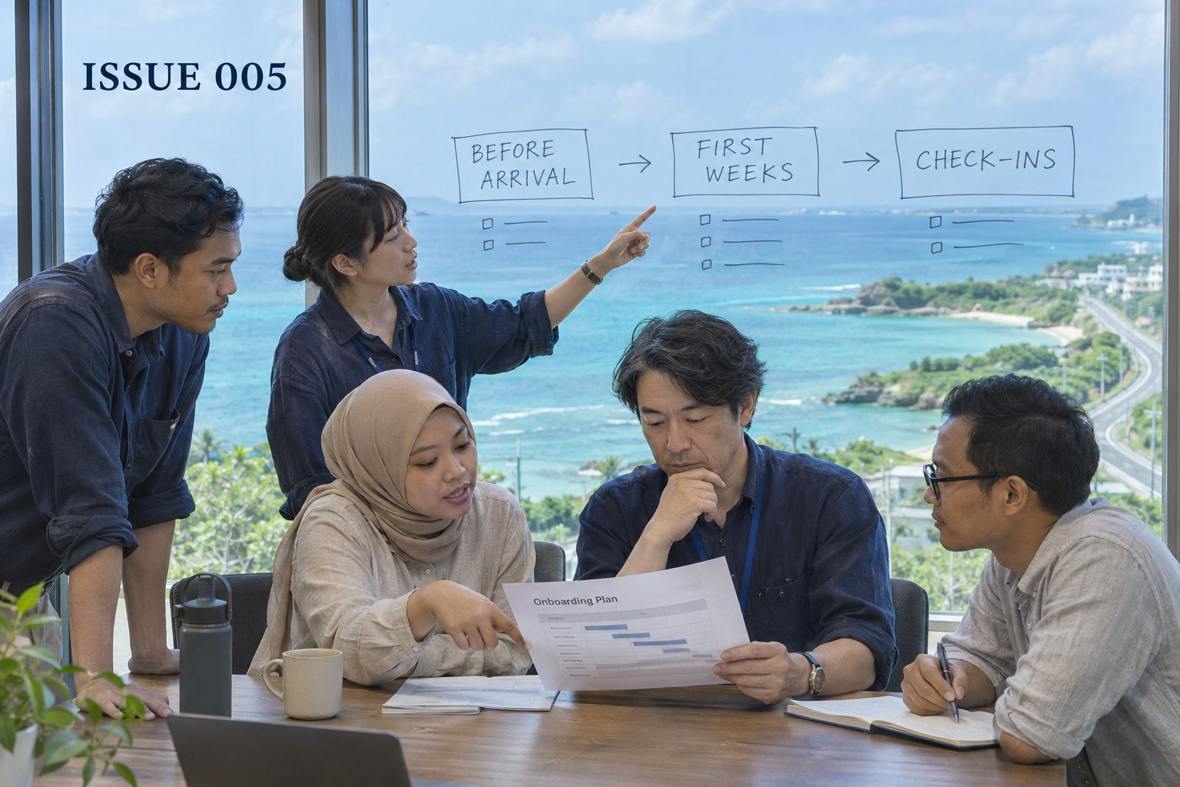
When companies recruit international workers, they face many practical questions.
Where can they find suitable candidates? What level of Japanese is required? How much time and money will the process involve?
These are important business considerations.
But I believe another question deserves equal attention.
Is the organization prepared to help new employees learn, grow, and build a sustainable working life?
Recruitment and retention are often treated as separate challenges.
Yet many of the conditions that influence an employee's experience can be designed before their first day.
Who will support their learning? How will work be explained? Who can they turn to when they need help?
If these questions remain unanswered, employees may face challenges that individual effort alone cannot resolve.
Recruitment brings people into an organization.
Retention depends partly on the relationships, opportunities, and working conditions that develop afterward.
The two should not be separated.
Connecting language education with workplace learning
Japanese language education is essential for international workers.
However, preparing for a language examination is not the same as communicating effectively in a workplace.
In elderly care, for example, employees may need to speak with residents, report changes in their condition, share information during handovers, and confirm instructions.
These situations require practical communication skills.
This is why pre-arrival education and workplace training should form a connected learning pathway.
What should employees learn before arriving in Japan? What should they develop after joining the workplace? Who will assess their understanding and support their next steps?
These questions should be considered together.
I do not want Japanese language education to be viewed merely as a recruitment requirement.
Japanese language is not a skill. It is infrastructure.
Language proficiency is an important skill. But effective communication is also part of the infrastructure that enables an organization to function.
That infrastructure depends not only on the learner, but also on how supervisors communicate and how workplaces provide support.
Retention depends on everyday organizational practices
Retention strategies often focus on benefits and support for daily living.
These matter.
But employees' everyday experiences also deserve attention.
Can they ask questions without fear? Can they recognize their own progress? Do they trust their supervisors?
These conditions may influence whether people feel able and willing to continue working.
In care workplaces, organizations must balance learning opportunities with professional responsibility and safety.
Supporting employees does not mean overlooking mistakes.
It means identifying what happened, providing appropriate guidance, and creating opportunities to learn and improve.
Encouraging questions does not mean lowering standards.
Good organizational design makes it possible for people to learn safely while remaining accountable for their work.
Three systems to prepare before recruitment ends
First, establish a clear learning pathway.
Connect pre-arrival Japanese education with workplace training and define the skills employees will develop at each stage.
Second, clarify support roles and responsibilities.
Identify the responsibilities of supervisors, workplace mentors, and relevant support organizations. Make it clear where employees can seek assistance.
Third, establish continuous feedback.
Review workplace understanding, communication, and employee experiences at regular intervals.
Rather than waiting until someone resigns to investigate problems, organizations should identify concerns early and respond constructively.
These systems do not need to be unnecessarily complicated.
What matters is that responsibilities are clear and support is consistently delivered.
Toward a new workforce development model between Okinawa and ASEAN
As I explore workforce partnerships between Okinawa, Japan, and ASEAN, I want to look beyond the movement of people across borders.
Educational institutions, employers, supervisors, and workers all have roles in building sustainable employment relationships.
Recruitment numbers alone cannot describe the quality of those relationships.
We should also consider learning progress, workplace communication, employee feedback, and organizational improvement.
Of course, retention is influenced by personal choices, family circumstances, and other factors beyond an employer's control.
The goal should not be to guarantee that every employee stays.
It should be to create a workplace where people have meaningful opportunities to grow, contribute, and choose to remain.
Hiring someone is not the finish line.
Building an organization where that person can develop and contribute is the real challenge.
Retention should not become a concern only after recruitment is complete.
It should be part of organizational design from the very beginning.
That is the direction in which I believe international workforce development needs to move.