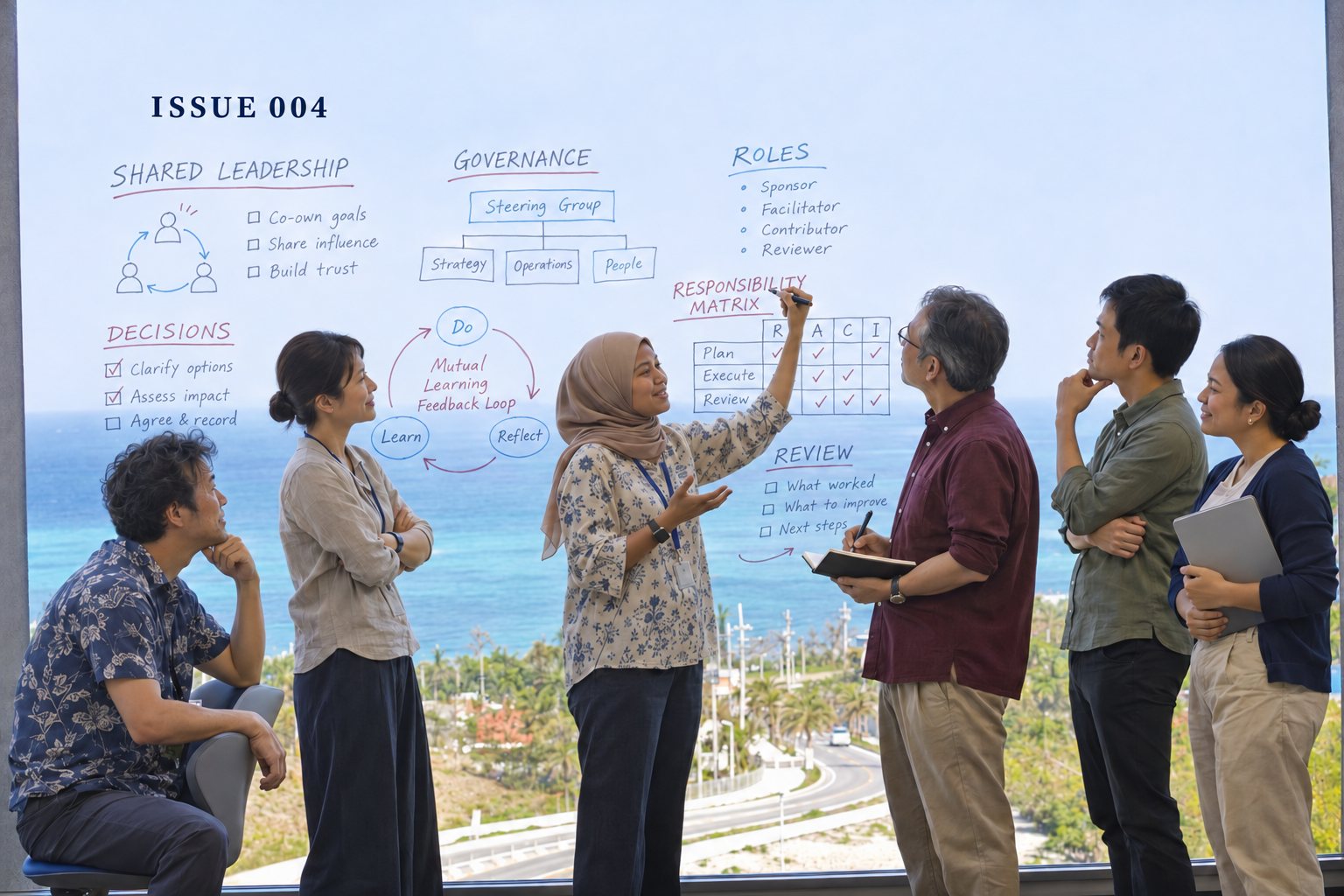
Rethinking organizational learning through international employment.
Beyond asking people to adapt
When companies in Japan recruit international workers, they often focus on language proficiency, workplace rules, and cultural adaptation.
These are important requirements.
But there is another question worth asking.
What is the receiving organization prepared to learn?
When people from different backgrounds join a workplace, should they be the only ones expected to change?
I believe international workforce development must be more than a one-way process of adaptation.
Just as individuals learn from organizations, organizations must learn from individuals.
Education is not a one-way process
In early childhood education, children are not simply passive recipients of knowledge.
They explore, experiment, ask questions, and learn through relationships.
Adults also learn by observing how children respond, think, and interact.
Education is not merely the transfer of knowledge from teacher to learner. It is also a process of mutual growth.
I believe the same principle applies to international workforce development.
Teaching Japanese and professional skills is essential. But employers must also examine how they communicate, support learning, and organize work.
An organization that develops people must be willing to develop itself.
Language education as organizational infrastructure
Consider a care workplace where an international employee struggles to understand an instruction.
Additional Japanese language training may help.
But is language proficiency the only issue?
Was the instruction clear? Were technical terms explained? Did the supervisor check understanding? Was the employee comfortable asking questions?
These questions concern organizational practices, not simply individual ability.
Japanese language is not a skill. It is infrastructure.
This does not mean language skills are unimportant.
It means effective communication should be supported by the organization, rather than treated solely as an individual responsibility.
Both the person learning Japanese and the person giving instructions have something to learn.
Three practical steps for employers
First, improve the clarity of instructions.
Use clear language, visual support when appropriate, and checks for understanding. In safety-critical situations, do not leave important instructions open to interpretation.
Second, create opportunities for mutual learning.
Training should include supervisors and local employees, not only international workers. Teams need opportunities to discuss communication challenges and learn from different perspectives.
Third, evaluate organizational change.
Language test results and job performance matter. But employers should also examine whether employees feel able to ask questions, whether instructions are understood, and whether feedback leads to improvements.
The goal is to assess not only how workers are developing, but how the organization itself is learning.
Building connections between Okinawa and ASEAN
In developing workforce partnerships between Okinawa, Japan, and ASEAN, recruitment should be the beginning, not the final objective.
Educational institutions, employers, and workers all have important roles in building sustainable relationships.
Success should not be defined only by how well international workers adapt to Japanese workplaces.
It should also include how workplaces improve through working with people from different backgrounds.
Welcoming people is not only about helping them change. It is also about being willing to change ourselves.
Those who teach must continue learning.
Those who welcome must remain open to change.
That is where organizations capable of developing people can begin.